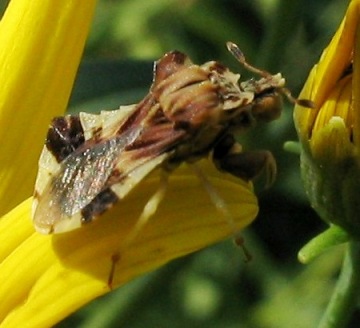
Insects in the subfamily Phymatinae are commonly called ambush bugs after their habit of lying in wait for prey relying on their superb camouflage. Armed with raptorial forelegs, ambush bugs routinely capture prey ten or more times their own size. They form a subgroup within the assassin bugs.
Phymatinae are 5–12 millimetres (0.20–0.47 in) long. In Phymata, the scutellum is triangular and shorter than the pronotum. In Macrocephalus the scutellum is narrow and rounded and extends to the tip of the abdomen.
Phymatinae normally have a large fore femur and clubbed antennae. The forewing membranes sometime lack distinct cells.
The antennae have four segments. There are two ocelli. The beak has three segments. The tarsi also have three segments. The rear half of the abdomen expands beyond the edges of the wings.
Phymatinae was often given family-level status and this classification is still used in some textbooks. Based on cladistic analyses, however, ambush bugs (Phymatinae) are part of the family Reduviidae (assassin bugs).
Source
Fog Bow
A fog bow is a similar phenomenon to a rainbow, however, as its name suggests, it appears as a bow in fog rather than rain. Because of the very small size of water droplets that cause fog—smaller than 0.05 millimetres (0.0020 in)—the fog bow has only very weak colors, with a red outer edge and bluish inner.
In many cases when the droplets are very small, fog bows appear white, and are therefore sometimes called white rainbows. This lack of color is a distinguishing feature from a glory, which has multiple pale colored rings caused by diffraction. When the droplets forming it are almost all of the same size the fog bow can have multiple inner rings, or supernumeraries, that are more strongly colored than the main bow. According to NASA:
The fogbow's lack of colors is caused by the smaller water drops ... so small that the wavelength of light becomes important. Diffraction smears out colors that would be created by larger rainbow water drops ...
A fog bow seen in clouds, typically from an aircraft looking downwards, is called a cloud bow. Mariners sometimes call fog bows sea-dogs.